
| Shaykh Muhammad Saleem Dhorat | |
| Mufti Muhammad Yunus Bullinger | |
| 2026 |
| German | Read | Download |
About the book
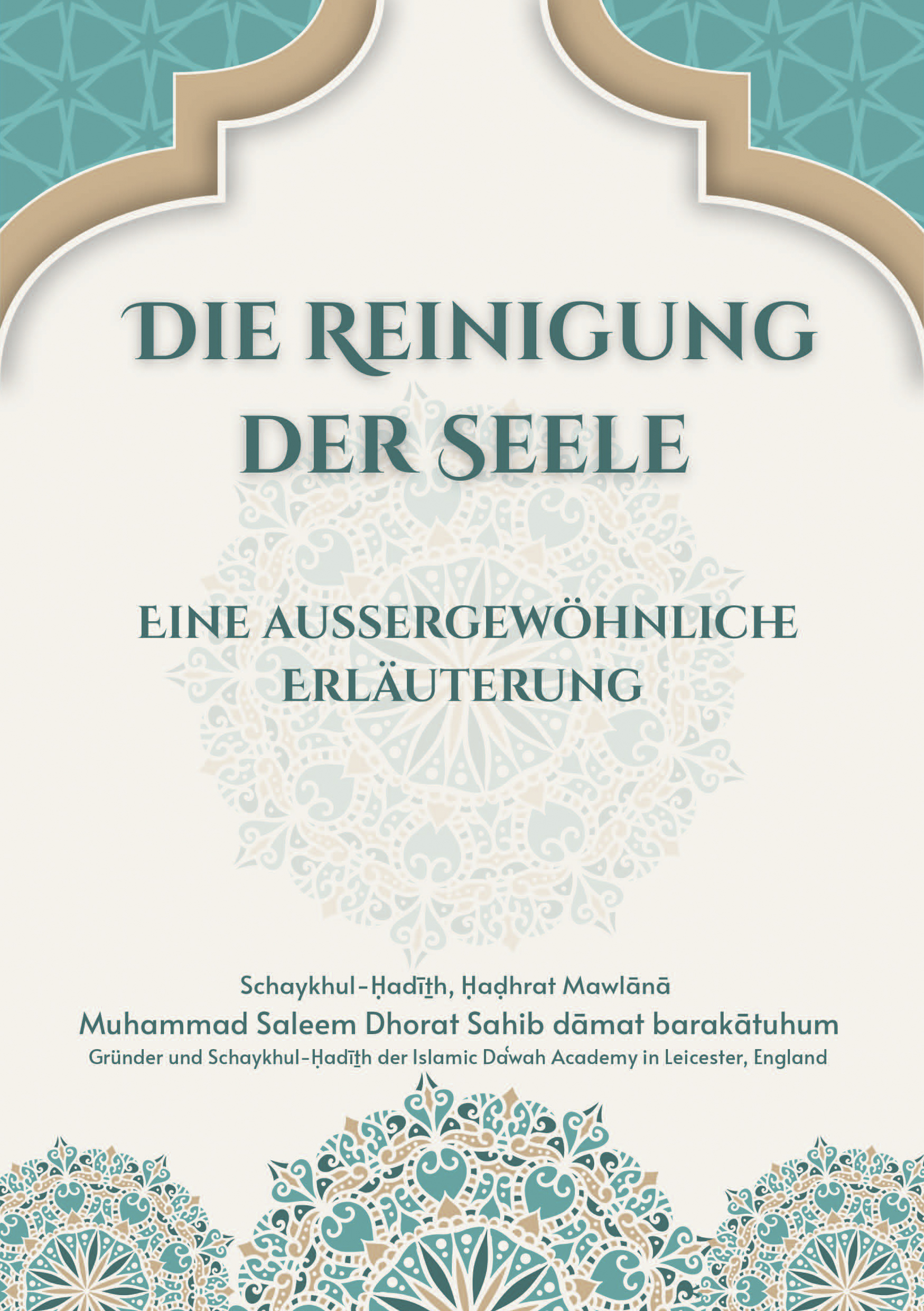
What is it that truly makes a human being — the body or the soul? Through strikingly vivid parables, Ḥaḍrat Mawlānā Muhammad Saleem Dhorat Sahib explains how the soul falls ill, what constitutes its food and what its medicine, and which three things are indispensable for the purification of the heart.
This booklet is the German rendering of a discourse delivered by Shaykhul-Ḥadīth Ḥaḍrat Mawlānā Muhammad Saleem Dhorat Sahib (dāmat barakātuhum) in Rabīʿul-Awwal 1437 (December 2015) at the Al-Falah Academy in Lusaka, Zambia, during an Iṣlāḥī Majlis — a gathering for spiritual rectification.
Its starting point is a simple yet far-reaching truth: of body and soul, it is the soul that is the essence. The body merely carries it through this world — much as an envelope carries a cheque, which is taken out upon arrival while the envelope is discarded. With remarkable clarity, Ḥaḍrat explains that Allāh Taʿālā has endowed every human being with two natural faculties — desire and anger — which are in themselves immense blessings and become illnesses only when they exceed the bounds of moderation. This is precisely where taṣawwuf begins: good deeds are the soul’s nourishment, sins its poison, the maʿmūlāt prescribed by the shaykh its medicine, the shaykh himself the physician, and the khānqāh the hospital.
From this parable the discourse develops a clear and practicable programme resting on three indispensable elements: mujāhadah (striving), constancy in the prescribed maʿmūlāt, and the ṣuḥbah (company) of the shaykh. Moving accounts from the lives of the mashā’ikh are woven throughout, alongside a consoling reminder: in our age there is no shortage of awliyā’ — the shortage lies solely in our own resolve.
The work includes forewords by Ḥaḍrat Mawlānā Muḥammad Qamruz-Zamān Sahib Ilāh Ābādī and Ḥaḍrat Mawlānā Muḥammad Ayyūb Sūrtī Sahib (dāmat barakātuhumā). It addresses everyone concerned with the rectification of the inner self — those setting out on the path as much as those who have already given bayʿah.
About the Author
Shaykhul-Ḥadīth Ḥaḍrat Mawlānā Muhammad Saleem Dhorat Sahib (dāmat barakātuhum) was born on 7 November 1962 in Bhoria, a small village in India. In 1973, at the age of eleven, he moved to England, where his father, Ḥāfiẓ Ibrāhīm Dhorat (raḥimahullāh), was serving as an Imām in Leicester. In 1980 he began his study of the Islamic sciences at Darul Uloom Al-ʿArabiyyah Al-Islāmiyyah in Bury, Lancashire — at that time the only institute of its kind in the United Kingdom — and graduated with honours. He then taught there for a further five years, including Ḥadīth, Fiqh and Arabic grammar.
In 1991 he founded the Islamic Daʿwah Academy (IDA) in Leicester. Beginning from his own home, it has grown into an internationally recognised institute of teaching, spiritual training and daʿwah, encompassing among others Jāmiʿah Riyāḍul ʿUlūm — where he himself teaches Ṣaḥīḥ al-Bukhārī — and the monthly journal “Riyāḍul Jannah”, published since the Academy’s earliest years. He is the author of numerous works and lectures throughout the world, with a particular emphasis on adherence to the Sunnah, the religious education of Muslim youth in the West, and above all on tazkiyah — the purification of the soul.
About the Translator
Mufti Muhammad Yunus Bullinger (born 1992) currently lives in Munich and works as an Imām, Chaṭīb, and religious teacher in Munich mosques. At a young age, he traveled to England to study Islām at a traditional Islamic madrasah. There he completed the Ḥifẓh and graduated with eight years of study in various Islamic sciences and the Arabic language. He then studied for three more years in South Africa and India, specializing in fiqh and hadith. He also received the traditional Ijāzah (permission) in the various Islamic sciences from his teachers. Since his return to Germany, he has made it his mission to translate and write Islamic literature for Muslims.